Showing posts with label Storyboard. Show all posts

Friday, December 16, 2011

Chief A.D’s Thinking. Part – 2 (1st A.D’s Tips Part – 2)


"Well, here's another nice mess you've gotten me into!"- Oliver Hardy, Sons of the Desert (1933)


Chief A.D's  Thinking. Part - 2


Continuing from where we left off in Chief A.D's Thinking Part-1 we cover a few more tips as to how a first assistant director (1st A.D.) looks at different departments. 


Also, read  How to plan a shoot in 10 easy steps. before you go ahead with these tips. 


In Part -2 we cover 

Director Understanding, 

Location / Set – Art, 

Lighting Shift and DOP’s Preference, 

Shoot order and Back up Plan.


Director Understanding


What I mean when I say director understanding is simply understanding the director, as the 1st A.D. understand what the director is trying to say and what the director wants to do. Remember the most important thing whether the director is an established one or even if he is a beginner, all they want is from the 1st A.D. is that the shoot should run smoothly. Most directors have a standard style of working, like some would do the shot breakdown only on the set just before the scene, some like to leave the entire day planning to 1st A.D. and don’t bother what needs to be shot next. Understanding their style can come from having worked with them or the production house earlier maybe asking people who have worked with them about how the director likes things done. The genre of the film also helps in understanding what needs to be done, like some directors concentrate on the style, so this guy would look very closely into details of props like fabric or lenses or kind of equipment being hired etc. Some like the actors to do most for the film so they would concentrate a lot on casting and would like spending time explaining and rehearsing with actors. This does not mean that the rest of the areas are overlooked but whatever be the style of your director its easier for you to function as you will know what areas you need to concentrate on and what areas maybe less important from the shooting point of view. Lastly in general Directors in features always look at the larger picture while advertising directors will be looking at minute details like even the colour of a prop in the background, the tv serial directors would be concerned with the timing of scenes (to fit the episode) and documentary directors would mainly worried if the point that they are trying to make is coming out or not.


Location / Set – Art


Shoot at a outdoor location 

Location v/s Set in features, TV series as well as in advertising, as a 1st A.D. it is important to know when the place would be ready to be handed over for shooting. In case of actual locations like airports or railway stations or landscape shots there usually, is no set dressing or a few props to be placed and one can begin shooting as soon as the DOP is ready to roll. Sometimes in these cases where some propping has to be done the art team needs to be made aware of the time available in which to finish it. Public locations like streets or like the ones mentioned are usually available only for a few hours and therefore reaching these locations on time and fully prepared helps. Planning and finding a base that is as close as possible to these locations and getting all ready in advance there before moving to the final filming location helps. In the case of locations that are houses or mills or places like stores, there could be a bit of propping that needs to be done and the A.D. needs to find out how long this would take. 


Indoor built set for a shoot

In case where a Set is required, set construction is followed by set propping and after which lighting can begin, as an A.D. when meeting with the art team one would have get a timeline from the art director for each and every location so that the final schedule fall into place. E.g:- a project that involves set as well locations the A.D. will have to find out these details and make sure the set construction has begun on time so that the floor is ready for shoot on the desired date keeping the time taken for lighting in mind as well. Set construction could go on for days or even months if the detailing is elaborate, there also needs to be the meeting between the Art and the DOP and VFX team (if any) to figure practical light sources and if any part needs to be constructed in such a manner to suit easy filming, like movable wall’s or extra windows or in case of VFX like a portable chroma wall or even a moving set like in case of an airplane, ship interior.


Set built of a ship's cabin

The bottom line wherever you are shooting is that a time frame has to be agreed upon and stuck to by the art team, direction team, and the producer who has to make sure that all is done so that this can fall into place. As simple as this may sound if there are minor delays here it will just spiral into a lot more other problems. Like a delay in obtaining the location for artwork to being might delay it being ready for the shoot which in turn will delay the start of the shoot and that could throw a lot more things out of gear.


Its always good to have at least one dedicated A.D. to art especially in features and TV series where continuity of set, and props go over a period of many days. These days it's easy for the A.D. to keep continuity using a simple digital camera, as long as the pictures are clear and organised into folders with details the job on set is fairly simple and yet could go drastically wrong if no one is paying attention, like same props being used in 2 different locations.

Lastly don’t forget to clear all the requirement lists with the art and production team, this is one space that mostly goes into a grey area where art says this needs to be done by production or vice versa, you don’t want to be stuck on set where one assumed the other is getting it. It's best to have lists typed and copies given to each department so that all know what they are responsible for and the job gets done.

Lighting Shift and DOP’s Preference


So depending on whether your shoot location is a built-up set or an existing location your cinematographer (DOP) will ask you for a certain amount of time to light up the place. In places where lighting is not possible like a street or a market usually the time taken for the DOP to be ready would be the amount of time taken to load up the camera and rig it if necessary and you are ready to roll. This does not mean that there may be no lighting in these places, there could be sometimes the placement of reflectors and or large lights at distances to add fill or spotlight in the environment.     

In cases of controlled environment mostly indoor locations and in cases of where u are on a constructed set, the DOP and the gaffer would determine the no of lights that would be required to light up the place and in turn how long would it take for the lights to get set up and be ready to roll, this could vary from a few hours to half a shift to even a full lighting day or two depending on the size and kind of lighting required. 

As an A.D. once you have this information it helps to determine the time required by the DOP and his team to be ready to roll the first shot of the day. So now depending on the kind of shot’s to be taken (Storyboard or shot break down) which is decided by the director you would go about planning the shots from the time for the first roll onward's. You have to try and fit all the shots planned for that day and make sure that there is sufficient time to finish all the planned shots, or complete the scene, in case of shooting for more than one-day balance shots could continue the next day but be careful that too much of shots moved to the next day might increase the work the next day and if further moved then shots or scenes required from that location might not finish and therefore leave you with an incomplete scene or a film. Generally, a large amount of time goes into the first shot of the day and you pick up pace after that, this happens because you want everything to be right and all departments to fall in gear before you proceed. Also once all the master lighting is done there is a lesser amount of shifting of light’s (compared to the master) for the shots to progress.

Remember to ask the cinematographer his preference for shooting order, (either at the recce or the previous day if needed) but do so only after u have a plan already ready so u can discuss it out, don’t forget to include the director in the plan if not at the discussion the stage at least before you lock on your final shoot order. Remember to keep all other factors in mind in this discussion like time of actors arrival or time required for special equipment  or prop to arrive so that u don’t plan something and have to change it last min.


Shoot order and Back up Plan.


Planning your shoot order usually happens the day before the shoot, this could be because you could have had balance shots from the previous day, or the director or DOP might have a preference to being with. That does not mean that you should not have a basic plan ready in advance. Irrespective of where you are shooting, in scheduling you would give a large amount of time to the first shot of the day as getting everything right for the first usually takes time, you generally pick up speed after you have taken your first shot. Most of the time you would plan your shots one axis at a time and scene wise, you would complete one scene and then move to the next unless the other scenes are similar in continuity and you can afford to shoot 2 scenes simultaneously. You finish all shots from one axis before moving to the other, rarely does one jump axis from shot to shot in a scene. This usually happens when the scene is acting dependent (some director's like to do it this way) or if there is permanent damage by the end of the scene like breaking of a key prop.

Basic plans per axis are the wide master shot is covered first then you would get closer into the scene ending up with close-ups. You would make a basic plan in this manner in advance and then discuss it with the director and DOP before you finalise the plan. When you have your plan in mind you should also have justifications to the order that you have planned and be open to suggestions before fixing the final plan. Light plays a huge factor in a shoot especially outdoors and the director and the DOP might want to shoot a particular scene at a particular hour of the day, like sunset or backlit scene’s. You have to have alternate plans here as on the day of the shoot your plan might change completely, like late arrival or a key prop or an actor. Here is where knowing everything that is happening in all departments help as that decision to change shoot order affects all and could make or break the entire shoot.


Axis Plan

 If you have the time, and you have all the shots that you have to shoot numbered you can make an Axis Plan (like the one above)  this is something that I would do especially on shoots that have a large number of the axis to be kept in mind and shoot in the same location for the same scene (or a commercial) it helps a lot in sequences that have stunts or visual effects to go with it. It's easy to see from this if you have covered all your shots for that sequence. The above Axis plan was done for a Limca Commercial which had a lot of VFX involved and since it was an outdoor shoot the plans had to be bang on.

Lastly, after you have done your schedule for the day, you can  do a time division to each shot and see if all your shots fit within your planned shift. Don’t forget to include your break time and keep buffer for each scene, for e.g:- in a 9-9 shift if you roll call is 10:30 am (assuming that major part of lighting would have already been done or only an hour and a half is required to light up) your first master shot you would assign 2.5 hours, this is from 9 am  - 11:30 am assuming that after the first roll (which usually gets delayed) you would take reset time and do  3 – 4 takes of the same, so this time has a buffer of 15- 20 mins, your next timing would be 11:30 – 12 for shot 2 of the day, 12- 12:30 for shot 3, 12:30 – 1:30 for shot 4, lunch from 1:30 – 2:30 and so on. You would keep a buffer time of 10 – 20 mins for small shifts in axis and 30 – 1hr or more for complete shifts in axis (like a cross over’s where a lot of things have to shift and be reset.) It’s not always possible to plan in such a manner as shots could be added or changed at the last moment, sometimes the director does not even plan the number of shots per scene till they are on the set, in such cases you could keep your division to scene timings, like scene 1 to be shot could take 2 hr’s scene 2 could take 1.5 hr’s etc so that you know that you have to complete those many scene’s by a certain amount of time so that you could push for work to move faster if you are falling behind the schedule.

You could print your timings for each scene on the call sheet to let all know if they are behind or ahead of the schedule. This is not a known practice at all, but I did it sometimes as it helped to keep everyone on their toes right from the beginning instead of trying to push too much at the last minute.   

More of these Tip's coming up in Chief A.D's Thinking. Part -3 


Auggieism:- What do you call a blogging Auggie... . 
Ans:- Bloggie..


For more interesting articles click on Auggielicious Index to see the entire list.
Like / Follow on the Facebook page Auggielicious for information, latest news, job posts etc..

Thursday, September 1, 2011

Chief A.D's Thinking. Part -1 (1st A.D's Tips Part - 1)

"I'm king of the world!" - Leonardo DiCaprio, Titanic (1997)

Chief A.D's  Thinking. Part - 1


As a chief assistant director or first assistant director (1st A.D.) the way you look at all departments is a bit different than the way the director’s assistant (D.A.) or the director looks at that department. This blog is in continuation of the previous one How to plan a shoot in 10 easy steps. and this gives you the 1st A.D.’s perspective to each department and understanding these might give you some tips on how to make your shoot a smoother one.


Remember not all projects are the same and therefore do not follow all tips and suggestions blindly, each project is unique and one has to develop a style that suits all departments but mainly works for that project. There are software’s that help planning and scheduling a shoot like Ep-Scheduling, Celtx , Gorilla, Reel Production Calendar, etc while some of these are free you have to buy most of them, so before spending the producer's money do a bit of research and choose what software suits the best to that project or choose what you have used in the past and are comfortable with. While these software’s do help in large productions not always will one get the budget for picking up a planning software. Here one has to plan using tools like excel or word and try to bring in the same accuracy these software’s provide. 

The following perspective’s on each department give a bit of insight into planning and scheduling without the help of software’s. Like said in the 10 easy steps first one has to read all material, and then one does a breakdown of it. In this blog, we cover Script Breakdown, Genre of the scene, Number of Shoot Days and Actor’s availability and timing. I would put all these under the direction and production team's responsibility. 

Script Breakdown

As the 1st A.D. you have to know the script and maybe storyboard thoroughly. In features, it is reading the entire script and knowing what the story is quite well, in advertising it's knowing the storyboard by heart almost frame by frame, in serials reading the script in advance and knowing where the story is going helps, while in documentaries there rarely is the role of any 1st A.D’s if there are any assistants then they usually double up as production assistant as documentary’s rarely have a large crew. After reading your script you have to break it down get what’s required to plan your shoot from it. Below is the minimum information that would be needed to process in order to plan a smooth day's shoot. 

Sc No
Storyboard 
 Image
Description
Audio / Dialogues
Loc
-ation
Actors
Costumes
Art
VFX / Special Equipment
Remarks
4c
scene opens on a wide shot of a camp...
“I am coming..”
Hero camp
area
Hero
+
camp
extras
Hero in 
Set – 1
As per art break up
20x 20 
blue Chroma 
+ 
 Jimmy Jib
Camp
area  to be kept clean


Depending on the script and the style that you develop as the 1st A.D. stuff like the axis of the shoot, day/night, animals, hair n makeup or anything else that the script calls for can be added to this. Art can be further broken down into set/location dressing and key props. Some times when there is too much information or there will be a repeat in information a totally separate sheet is used and they are then coded which could be Set -1, Set- 2 or Costume 1, Costume -2 etc  Once you have done this break up it will give you a fair idea of the combination of the various elements that would be required so that time is used most efficiently at the shoot. In features you can use one sheet per scene to do the breakdown, this helps when combining scenes from all over the film to put your sheets in the order of the schedule and see if it fits all requirements. This is quite similar to what some of the software looks like Below is an example of what that looks like.


What you need to find after this exercise mainly is what is the key driver of the shoot? (importance could be different across different scenes) is it the actor or the equipment or VFX. A lot of times there will be more than one important factor that would drive the planning of the shooting order. You would then use your experience and assign the minimum time to the maximum time required so that the day's schedule can be completed without any hassle.

Sometimes there is not much time to get into this amount of detailing, in that case, one can also use different coloured highlighters and mark it out on the script, like actors (yellow) Art n Props (green) locations (blue) etc then coloured copies of these can be made and each department will have a colour to follow.


Genre of the scene


What makes shoot planning easier is knowing the genre of the film or rather more importantly of the scene to be shot. You arrive at the time required for each scene basis this like in a stunts sequence prep time before each take is quite long, sometimes you have only one attempt at filming it like in explosions or accidents, here you have to get all things right and everything needs to be double-checked before rolling that takes time. Or in case of a hair commercial the hair flying shot, or packshot in case of commercials reset time needs to be considered. Luck also has to play a huge role in trying to divide the no of the shot’s to be taken in a day as anything could go wrong or right, the hair will fail to bounce or the product splash won’t happen the right way, knowing how little time is left for the shoot to warp and how critical it is to get the right hair shot so that you could advise the director that either time is running out and therefore to move on to the remainder shots or when asked to say that we could attempt one more take if the shoot is on track and you can afford that time. In short, this helps in knowing how long that scene would take to shoot.  


Number of Shoot Days


The number of shoot days represents the shooting schedule or the number of days that the producer allocates according to the budget. Within this, there are usually breakups depending on a different number of locations, the distance between locations, and no of the scenes to be shot per location.  The first A.D. has to divide the number of scenes into the number of days allocated at each location and see if there is sufficient time to finish all scenes in the script at that location, if the number of days are not allocated then you would combine all the same location scenes through the film and then divide them into the time required to shoot per scene, add that up and you arrive at the number of days required at each location. For eg, 10 scenes in total at Location A, depending on the type of scene you will assign each of these scenes the number of hours you think it would take to shoot that scene, (here is where the previous points come in handy) therefore scene 1 = 2hrs, scene 2 = 1 hour, scene 3 = 4 hours and so on, then you will total the number of hours and divide it across the feasible shifts and you arrive at the no of shoot days or more precisely the no of shifts required.  You have to keep in mind master lighting of the location/set which could be part of the shooting days or extra. 

In advertising where usually it is one location, it’s easier to plan, it’s when u have multiple locations when this kind of breakups do help. There are ad's which are shot over multiple locations and here knowing distance and time taken between locations, how fast would it take for the crew to shift bases or is there one base and multiple spots close to that the main base while most of the crew then move on smaller mobile units. Here the challenge of scheduling is greater as usually, you have had a lot to do and much lesser time to it in.     

In Tv serials usually, the time allotted is that at the end of the day the producer should have a minimum of  18 mins of edit time which is the time required for 30 min episode. The time could be across episodes but is what is required for feasibility, in daily soaps there is usually some who is only in charge of scheduling as it takes quite a bit of time getting all combinations of actors and various locations in place and since most serials are shooting on a daily basis it requires someone dedicated to only doing this.

In documentaries, if it is budget dependent then one shoots till one is out of money or has the full story covered. Since the crews in most cases are small sometimes just the cameraman and director or even times when its just one person doing all the work, the main thing to get here is to cover as much as is required to finish a good documentary.


Actor’s availability and timing


Another step in planning your shoot especially if it involves lots of actors over various scenes is to know at the beginning what their available dates are. 

In features there needs to be a larger plan drawn up so that all scenes and locations are covered, usually, the A.D. would club all the same location scene’s together, then check the actor combination and date availability, going by the method the AD would request for actors availability at each location by trying to club all their scenes together, this is where it gets tough more the no of characters involved in scenes the more complex it gets when trying to club. It gets even tougher when one is shooting outdoors as actors have to be flown in and out and you calling an actor to travel twice to the location over a few days could add quite a lot to the producer's budget. In India, there is a reverse way that also happens when big celebrity stars are involved. Here the dates of the stars are given and then the A.D. has to try and finish all the scenes with that actor on the dates given, this usually results in shooting at various locations and coming back to the same locations to complete the remainder scenes at that location which is not ideal, there is a very thin silver lining to this, usually, these stars give the producer block dates, which could be anything from 1 week to 2 months, so it’s easier to schedule then. Another thing to be kept in mind when dealing with stars is their punctuality, each of these usually follow a pattern, like some will always come 3 hours later to the call time while some are bang on time, it’s important to know this as that helps in planning the day and covering as much without the crew waiting idle for stars to arrive. When working with these stars for the first time one can always find out about their patterns by asking other A.D’s who have worked with them earlier.

The same planning is required even further more in advertising when shooting with a celebrity, there is usually only one or two days of shoot and if time is spent waiting the producer might go in a huge loss if the shoot goes up by even by half a shift. Having said this one cannot keep the star waiting once they have arrived, in advertising usually these stars give only a limited amount of time, and extension of that could cost the client for a whole day more.

Some of these shift timings for stars begin from the time they leave their residence and therefore travel time to the location is also counted in their total time, eg:- if a star gives 8 hours for a brand for a day’s shoot then the clock begins from the time they leave home and if it takes 2 hrs to reach location then you are left with 6 hours to finish with them which includes hair, makeup, wardrobe, in effect you may end up with only 4 hours of the star on the shooting floor, so real smart planning is required in these cases. In non-star cases the A.D. can plan the shoot whichever way is best suited for that project.

In Tv, serials it's up to the person scheduling to figure out the dates in advance so that perfect combinations can be scheduled. The lead cast are usually available throughout the schedule while most of the secondary cast have no pf days per month as contracts, so an actor might give 3 - 4 days per month only as per contract and any further day costs the producer. Here when u have 3 or more such actors to deal with is when scheduling gets really tricky. The best way is to plan early to have the entire month plan drawn up before the schedule can begin and that way all the possible ways to combine have been considered.

In documentaries, if the subject is a person then his availability to the filmmaker had to be obtained, if its a topic where different people are involved then again finding out the right time to get from them in advance is required.   


Check out Chief A.D's Thinking. Part -2 as well, 

More of these coming up in Chief A.D's Thinking. Part -3.


Auggieism:- What do you call Auggie with a whip.... 
Ans:-  Floggie....


For more interesting articles click on Auggielicious Index to see the entire list.
Like / Follow on the Facebook page Auggielicious for information, latest news, job posts etc..


Tuesday, May 31, 2011

Panasonic Dimensions 3D film competition

Panasonic Dimensions 3D film competition:-


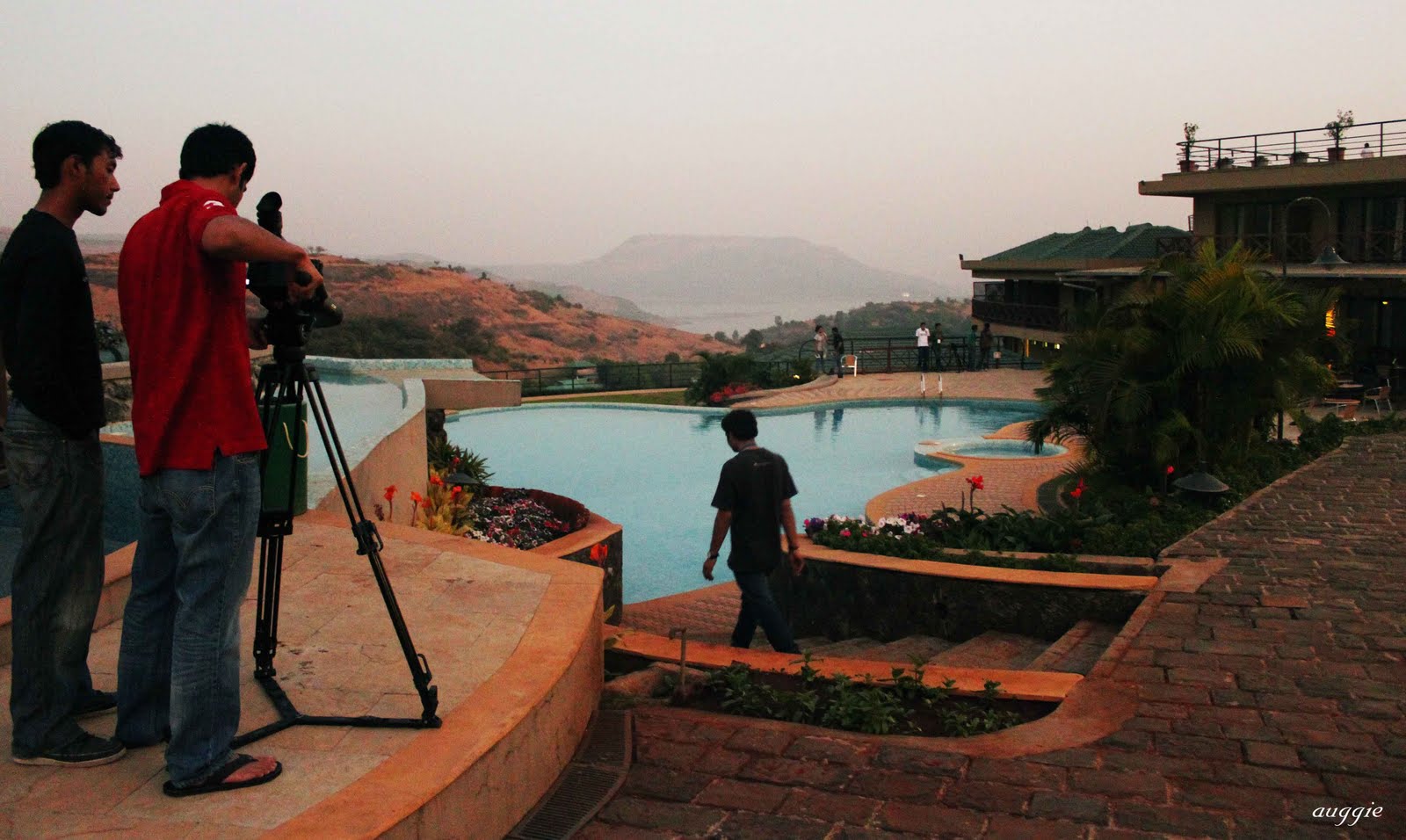
A 3D competition put together by Panasonic where 7 film schools across India participated in a short duration movie/documentary making contest in 3D, a workshop at Upper Deck @ Lonavala where Barry Braverman (DOP / 3D expert) took everyone through the basics of 3D in quite a depth at the same time introducing Panasonic's AG-3DA1 camera.

Upper Deck - Lonavala

You can check this page for the specs and some basics of the camera and 3D:-
http://pro-av.panasonic.net/en/3d/ag-3da1/index.html


Film schools that participated in this competition were
LV Prasad - Chennai

Chennai Film Industrial School (CFIS) - Chennai

Asian Academy of Film and Television (AAFT) - Delhi

NDTVmi - Delhi

Film and Television Institute of India (FTII) - Pune

Symbiosis Institute of Media and Communication (SIMC) - Pune

Satyajit Ray Film and Television Institute - Kolkata


The entire gang.


In the workshop, Barry not only covered 3D but also looked into storytelling and how one could use 3D to enhance the story by using it. The limitations and the so-called rules or basic principals one could say were also shared during the course of this workshop.  


A bunch of professionals from the industry including me, were asked to act as mentors or creative producers, our responsibility was to make sure that while creativity was given a free hand there were no basics that were overlooked and a check on budgets of course. Nikhil Gonsalves was the chief producer and all teams had to report to him.

The mentors along with Barry and Nikhil.

The fields from which each mentor come are as follows:-
Satyanshu Singh - Scriptwriter
Arjun Venkatesh - Cinematographer
Rohan Talwalkar - Assistant Director
Augustine Fernandes (Auggie) - Director. 
Chirag Patel - Cinematographer / Photographer
Tunali Mukherjee - Photographer / Writer
Kumar Devanshu - Scriptwriter


Over the 3 days, the teams were given a chance to use 3D cameras, so that technical questions mainly because of the medium could be sorted, also limits of the camera and medium were figured. Each team had to work on stories which they had to pitch and only after all the producers were happy were the teams given a green signal for that story to be their 3D film which they would work on following the workshop. While pitching each team had to have back up ideas in case the one pitched failed to make the cut, also they had to come up with a Title, log line (story in one line or something that is memorable from the film), and a poster for the pitch. (This is something that a few directors go through when they try to sell their script to producers or financiers)


Post the workshop teams returned to their colleges and work on their storyboards, location recce, casting, costumes and mainly budgeting, dates were fixed post-budget approvals and this followed by prep and shoot. All teams were given sufficient time and were called in batches for their respective edits at Qlabs in Mumbai, the process involved a basic 2D edit a 3D conform, DI while dubs and sound mix on 5.1 Dolby. The finished films were burnt onto blu ray and were ready for judging.

The judging was done by none other than
Rajkumar Hirani 
Nikhil Advani  and
Karan Johar

So while the winning team got to fly to LA to visit the Panasonic Studios the rest of us took back the fact that we were among the rare few who got to learn and work in a medium that is still in the developing stage. We also got to take back memories along with a whole bunch of new friends from across the country.

You can watch the episodes that were covered by NDTV and which were aired in the links below
(Don't know how long these links will last though.)

Episode 1

Episode 2

Episode 3

Final Episode


For more interesting articles click on Auggielicious Index to see the entire list.
Like / Follow on the Facebook page Auggielicious for information, latest news, job posts etc..


Friday, July 2, 2010

Wanna be a..... Director

“This isn’t personal, Kay. This is business”, Michael Corleone - The Godfather , (1972)

Wanna be a..... Director


Want to be part of the glamour but don’t know what to do.? Can’t make up your mind if you want to be a Director or a Cinematographer or a Music Director... read on as I give you an insight which no film school will ever tell you. This blog is on if you Wanna be Director.  Most of this is based on my experience in India and figures would vary as time passes.


POST: Director


JOB PROFILE:


A Director is the leader of the project mainly in terms of vision and direction. He is responsible for decision making and it’s his style and effort that shows in the end. He is responsible for the acting, style of shoot, the technical direction, etc. The director is the one who takes it from the story to the screen, he also participates in choosing the team, at least that of the key crew,(mainly the head of the departments) also the cast gets finalised only after the director’s approval. He has meetings with the head of almost all departments before the film goes into production and also has rehearsals with the actors sometimes (if time is available) He uses scripts, storyboards, references when meeting with these departments to show and explain to the team what he feels the film should look and feel like.

Lots of time the director becomes or feels like an answering machine. A yes or no, eg, when costumes come back after the briefing with references then it’s the director who says yes or no to colours, material, and so on and so forth. The same goes for all other departments. The director has also to work with the post team, influencing the grade of the film, with the editor to check for cuts and the flow of the story, etc.

EXPERIENCE REQUIRED:


Anyone with a vision can become a director, there are people who become directors based on experience, some on qualification, and some just by the influence they bring. 

Experience can be gained by working closely with good and bad directors, working with different people show you different styles of working, also different production houses also function differently, so it helps in choosing a way that suits your style and also one that is right for production. 

For people who are new to the industry and want to be part of it, there are various courses that one could take up to learn the art. These days one can graduate with a BMM degree – Bachelors in Mass Media, this is a 3-year course and teaches you the basics of all media-related industries including journalism, market research. Although this course does not prepare you for direction, it gives you an overall about media. There are also government-run institutes like the F.T.I.I. - http://www.ftiindia.com/ and private ones that offer specialized and general courses for those who have already done their graduation. One could also choose from courses abroad like 


You could also check these site’s out which has a list of schools from across the world


The way to choose the best schools to learn is to check the course duration, the syllabus, topics covered, the teachers, their real-life experience with film making, what are the practical’s the course offers, the library, and of course the fees, if one is leaving their country then place to stay and those expenses of upkeep also have to be kept in mind while choosing what’s best for you.  
If you trying to get through this industry then you better hope that you come from a family with a lot of influence in the industry or are just plain rich to finance your ventures.

TIMINGS:


Depending on experience and how quickly he can make decisions the time spent by directors at work may vary. During the shooting phase, the director almost always is there from the start to the end. (except during pre-light) the time and effort of Pre and post vary. 

Documentary directors = since a lot of research goes into documentary’s lots of time the research time is the same as shoot as usually the documentaries are made up of findings and interviews which are usually shot at the first attempt. In other words, the amount of time spent would be equal to the passion for the subject.  

Daily soap / Serials = minimum time few hours a day ranging from 2-6 hours during the planning days, and during shoot depending on the availability of actors and locations the time on the shoot, days are the normal one and half shift, to even 2 shifts sometimes.  

News (non-news episodes) / MTV kind of serials (where the director and producer are the same people) = usually full days ranging from 8 – 12 hours or even more, most f the times these are hired employees so office timings would apply,  the shoot timings are generally ranging from one shift to 2 shifts.

Promos and Advertising = depending on the team provided and the quickness at which the director takes decisions’ time spent could be ranging from 8 – 12 hours to sometimes even 20 hours if things don’t fall in place in pre (especially just before PPM’s and shoot days). During shoot which usually lasts 2- 4 days generally, it’s a similar one and half to 2 shifts.

Features = depending on the time spent in Pre-production the director would give that much of time per day. Since pre in feature films usually take months the director usually doesn’t need to kill himself at the office every day, time spent could be ranging from 2-4 hours on an average to 6-8 hours on some days. Most of these are time spent in meetings. The shoot lasts sometimes for months, and mostly its the standard one and half shift per day.

PROFITABILITY:


Documentary Directors – depending on if it is commissioned or if it is being done out of passion one could make nothing to a few thousand. Documentaries are rarely very profitable monetarily at least. The commissioned ones, at least some of them do make a decent amount.

Daily soap / Serials – directors here get paid per episode usually, though some do get monthly salaries. Money ranges from 10,000 Rs per episode to 25,000 Rs per episode could go up to 80k approximately which is mostly for weeklies. So on an average, it could range between 40k – 80K for beginners to 80K – 4lacks per month as experience increases.

News / MTV kind of serials – here the amount of money the director makes is in the hands of the director himself, especially if he is a freelancer and not on the payroll. What generally happens is a budget is given to the director and the amount he saves is up to the way he plays and makes deals with the crew they are hiring.

Promos and Advertising – the money made here depends on the deal made with the producer, the two ways are the director chargers a fee for the project (usually when the director is a freelancer or a beginner) or a percentage of the profit. In the first case a director could make 1 to 2 lacks per day of the shoot or a higher deal as agreed between him and the producers. Sometimes the deal also works in percentages of the total budget, 2% - 15% of the figure usually.  As far as percentages go a beginner could make anywhere between 10% - 15% and this could go up to 60% - 80% as experience and demand go up.  

Features – experience plays a huge role in the figure that a director makes. A first time director could make 5- 9 lacks for the film and as experience and hits come his way the figures could go up and there is no end figure that one could say he could make.

THE TEAM:


The director is the captain of the ship and all are the crew that gets hired to work for him. The immediate people who report to him are the direction team which is made up of DA’s and AD’s. The DA – Director’s Assistant sometimes also doubles up as an assistant director, and the number of assistants hired depends on the budget so ranging from 2 – even 7 and 8. The rest of the crew are Production and their team, line prouder and his local team, DOP and his team, camera, lights, grips, gaffer, special equipment like a crane or a Milo, costume’s, hair and make, stunts team, VFX team, transport, caterers, food stylists, and the list goes on and on. The hiring of these is obviously based on the requirement.

So now that you know what it is about being a director you can decide if you want to be one or specialize in some other department. Remember a director like any sportsperson is only as good as his last film, so if you have the talent for it I would say go for it and all the best.


For those who have no time to go to a film school or have already started working check out No Film School for more tips and learning


Auggieism:- What do you call a loyal Auggie... . 
Ans:- Doggie..


For more interesting articles click on Auggielicious Index to see the entire list.
Like / Follow on the Facebook page Auggielicious for information, latest news, job posts etc..


Friday, December 11, 2009

STORYBOARD

“Toto, I've (got) a feeling we're not in Kansas anymore." – The Wizard of Oz.

STORYBOARD

Love drawing cartoons, then storyboarding is for you. Storyboards work for all - features, Tv serials, AD films, and even for animation. It helps some more than the other.


What is a Storyboard?

A Storyboard is a way of pre-visualizing the director's thoughts or ideas (mainly scripts) into illustrations or images so that the director and the team can see what he plans to shoot or do.

What does a Storyboard look like?

A Storyboard is a series of still images or illustrations put in story order to explain to everyone what the director's vision is. They could just be images put in order which explains everything, or usually, there is a description alongside which describes the camera size (like wide, mid, etc) and the dialogues that go along with the frame. The dialogues could also be broken up based on the edit pattern that the director has in mind. For presentation the general norms are to have the image on the left and the description on the right, these could be 4 per page or if the other pattern of 2 a page is used then the description is put below the image. Sometimes this pattern is used to put as many images in one sheet as possible so that the entire story or scene is on one sheet so that the overall idea could be seen faster.
Storyboards can be done differently from 2D to 3D they can be done in black n white, or in colour, even still’s are sometimes clicked to make one. Storyboards can be done in detail, with as much information in it as possible, which means that camera lensing, set area, props, etc all included. This detailing helps all departments to plan what needs to be done by just looking at each frame. Sometimes there is not enough time or money to get the entire film boarded so key scenes or just keyframes are boarded. Further lack of time also calls for just doodles to be drawn by the side of the script to be a quick fix.

Where and to whom is a Storyboard the most useful?

It gives the directors, producers, cinematographers, commercial advertising clients, etc a tool to visualize the scenes and find potential problems before they occur. It helps in planning story flow for the edit and move shots around if need be. The AD’s can go ahead and plan the shoot accordingly to the board, which would help in saving time so that set up of shots don’t have to be repeated.
In commercials, the storyboard holds quite an important place in the process. Besides the shooting crew which follows the board quite closely, the first use of the storyboard starts at the pre-stage where the board is shared between agencies client and production house, here at this stage mostly each frame gets studied and based on this board changes are suggested based on brand guidelines and the image of the brand. Like the use of certain colours which match the brand, or the non-use of certain objects because of legal issues. All of this helps so that all corrections could be made before going ahead with the shoot which helps in saving of reshoots or any surprises left on the day of the shoot. The meeting which happens with the agency, production house and client is called a PPM - Pre Production Meeting, this is usually a few days before the shoot which gives enough time for the changes to happen, sometimes there are more than one PPM as either there too many changes or too many levels of clients to go through. (like when the main brand team belongs to another country)
The process of putting stills or a series of images along with a rough audio or a track together s called Animatics. This tool is increasingly used by advertisers and advertising agencies to research the effectiveness of their proposed storyboard before committing to a 'full up' television advertisement.

History of Storyboards?

It is said that the storyboarding process, in the form it is known today, was developed at the Walt Disney Studio during the early 1930s, the first storyboards at Disney evolved from comic-book-like "story sketches" to illustrate concepts for animated cartoon short subjects. Websitesand other interactive media projects are the most recent known use of Storyboarding during the design phase.

When and how does a Storyboard come about?

Well first obviously there needs to be a script or a screenplay, in advertising, this is usually coming from the creative team, in films is the script or screenplay writer from where this would come. Then the director has to break it into the no of shots or cuts that he wants to put into the film. Referencing through images is one of the key factors during the making of the board. Key things to know before starting are live location vs set, look of key props, the way the camera moves in certain cases and sometimes look of the costumes are also needed. If it’s a live location then a recce of the place before or pictures of the place in detail, or if it’s a set then a proper layout design of the place helps, here a meeting with the production designer (if there is one) or the art director, where a brief is given (along with the references) and then they draw up a plan based on which a storyboard is done. This holds true for most cases but sometimes the director may want to make a board and then brief the art director what all details he is looking for in the set. Either which ways the director has to have references of the kind of look of furniture or style of house etc to show the storyboard artist (Most of these references are chosen keeping the target audience in mind that is intended)
The key to a good board is how much it helps each department, so the more detail in the board the better, the no of cut one wants to have decided the no of frames to be drawn, a fast-paced film will have more number of cut’s, therefore, will have more frames. Montage, Action are usually the times when you have a lot of frames for a short period. For animation usually, almost all keyframes have to drawn as the team can then follow the direction correctly.

Different ways of making a Storyboard?

Besides the normal 2D drawing there is also 3D way of making storyboards. The advantage of 3D storyboards (also called 'technical previsualization') is they show exactly what the film camera will see using the lenses the film camera will use. The disadvantage of 3D is the amount of time it takes to build and construct the shots. 3D storyboards can be constructed using 3D animation programs or digital puppets within 3D programs. Some programs have a collection of low-resolution 3D figures which can aid in the process. Some 3D applications allow cinematographers to create "technical" storyboards which are optically-correct shots and frames.
Making of storyboards are also helped with a number of tools, StoryBoard Quick, StoryBoard Artist, Storyboard Pro, FrameForge3D, etc all these software basically helps a common man to make boards and not have to wait for a professional artist to come to work for you. They offer usually a range of sets and shapes of houses, cars, etc, some of these lets you import your own pictures so you can use the pictures from your location to see what you film would look like. Most of these come with customizable characters of male, female, age, height, colour, etc, etc.. you could also add audio to some of these and watch them back in proper timing.
If there is still doubt and clarity is required then shooting the script on a home camera or cellphone and then editing it down also helps in clearing the doubts, this could be done with the help of the actors as a rehearsal or with assistants, in any space. This edit helps all to see the problems that one may encounter in the final shooting, like the timing of actors, the number of cuts required, more or fewer shots to be taken, etc.
Lastly for live locations or usually when the set is ready, (on the tech recce) what also could be done is a what is called a walk thru, wherein the cinematographer or the director uses a still camera (ideally with different lenses – like the ones used in the board) and does a run through all the shots in the same blocking that is intended for the final shoot. If one has the budget then even the film camera with the intended lenses can be used and the rehearsal could be recorded on the video assist. (not rolling the film) This process is usually called blocking and is the first time a Storyboard can be seen in the semi-final state before the shoot. These stills if it is shot properly could be used as the final board before the shoot.
In Television serials and Feature films where time and money do not permit the making of detailed storyboard, just stating camera cuts at the side of the script Like dialogues are marked at the side from which to which is Wide and what dialogues go as a close-up, etc. So whatever you do, a detailed board or a doodle, having a shot breakup at least in your head is important.


Auggieism:- What would you say if Auggie got wet in the rains...
Ans:- Soggie..


For more interesting articles click on Auggielicious Index to see the entire list.
Like / Follow on the Facebook page Auggielicious for information, latest news, job posts etc..